
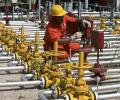
The government on Thursday hiked by 62 per cent the price of natural gas that is used to produce electricity, make fertilisers and turned into CNG to use as fuel in automobiles and cooking gas for household kitchens. This is the first increase in rates since April 2019 and comes on back of firming benchmark international prices but does not reflect the spurt in spot or current price of liquefied natural gas (LNG) witnessed during the last couple of weeks. The oil ministry's Petroleum Planning and Analysis Cell (PPAC) said the rates paid for gas produced from fields given to state-owned Oil and Natural Gas Corporation (ONGC) and Oil India Ltd (OIL) will be $2.90 per million British thermal unit for the six-month period beginning April 1.

Among Sensex components, shares of Reliance Industries, India's largest company by market value, stole the show by surging 1.61 per cent to their highest in over three months.

Reliance Industries raced to 52-week high on better than estimated earnings and announcement of bonus share.

While Bajaj Finance, Asian Paints, Tata Steel, NTPC and SBI were among the other gainers, ONGC, Axis Bank, Tech Mahindra, Infosys and ICICI Bank were among the laggards. NSE Nifty advanced 82.75 points or 0.73 per cent to settle at 11,470.25.

The 50-component Nifty closed at 10,214.75, a solid gain of 96.70 points, or 0.96 per cent

All the items identified for procurement from domestic defence manufacturers are used in shipbuilding. So far, the defence ministry has notified 127 items where purchase preference is given to local suppliers.
With the listing of Reliance Power, the market cap of Anil Ambani group aggregated to Rs 307,112 crore (Rs 3,071.12 billion), almost Rs 100,000 crore (Rs 1,000 billion) below expectations of Rs 400,000 crore (Rs 4,000 billion) capitalisation.

Salil Dhawan reveals the MFs that have not only performed well in the past but have a promising outlook for the future too.

Reliance Industries emerges biggest gainer
For its m-cap to more than double, RIL needs government nod for nearly doubling of its gas price of $8 per million British thermal unit together with approvals for oil and gas field investments.

Reliance Industries was the top gainer in the Sensex pack, rallying up to 15 per cent, followed by Kotak Bank, Maruti, HDFC twins, Titan, L&T and Axis Bank. On the other hand, IndusInd Bank, ONGC, ITC and Bajaj Auto closed with losses. the NSE Nifty settled 516.80 points, or 6.62 per cent, up at 8,317.85.

Experts attribute this trend to a combination of end of capital expenditure cycle, increased automation, RIL's preference for time-bound labour contracts, and telecom and retail's outsourced human resource model.

Riding on a stock market boom since 2009, India Inc's chief executives have been able to salvage a lot of lost pride in their second innings.

More than 10% (40 of 498 companies) have lost at least half their market value.

I would advise at least a 7 year investment time frame for Equity Investing

'The ability to tailor schemes to market conditions and invest in unlisted equity and real estate, as well as commodities, makes Alternative Investment Funds a sought after platform.'

TCS had replaced RIL as the most valued firm more than four years ago but a sharp rally in the shares of the Mukesh Ambani-led firm in the recent past has helped the company close the gap.

Bucking the overall downtrend, shares of RIL rallied nearly 10 per cent, capping the Sensex loss to a large extent.
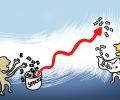
Ajit Mishra, vice president, Research, Religare Broking, answers queries on how to invest in stocks.
Most users are unhappy with the cap on 'unlimited' access plans. Broadband internet service providers need to make their networks more capable, feel most Indian subscribers.

Media has raised the issues that new pricing to benefit Reliance Industries.

At present 100% FDI is allowed, of which up to 49% investment in a company can be done through the automatic route

In a chat on rediff.com, Feroze Azeez offered valuable tips.
State-run Coal India on Wednesday toppled billionaire Mukesh Ambani-led Reliance Industries as the country's most valued company, with a slightly higher market valuation around mid-day.

Insurance companies are seeking a separate deduction limit of Rs 1 lakh for insurance premium payment under Section 80C of the Income Tax Act in the upcoming Union Budget to bring in more people under the ambit of insurance. The insurers also want reduction in the goods and services tax (GST) rate of 18 per cent currently applied on health insurance products to 5 per cent to make such products more affordable to common people. Finance Minister Nirmala Sitharaman will present the Union Budget for 2022-23 on February 1.

The BSE Midcap index has declined 5.7% thus far in May 2018. In comparison, the S&P BSE Small-cap index has lost 5.6%

Since last month, the realty (down 23%), auto (down 16%) and finance (down 14%) indices have underperformed the market by falling over 13%, as against 8% decline in the benchmark indices

SBI had a bad day, sliding the most by 5.36%. Others that dragged the key indices down were M&M, Reliance Industries and L&T.

The one common theme across companies that have rewarded shareholders is consumption.

Yes Bank was the biggest loser in the Sensex pack in absolute terms, cracking 12.85 per cent, after the company reported a massive 92.44 per cent slump in consolidated net profit to Rs 95.56 crore. ONGC, Tata Motors, M&M, Maruti, Vedanta, Bajaj Auto, TCS, SBI and HCL Tech lost up to 4.24 per cent.

Looking to monetise assets not in Reliance Capital's core area of business.

Sun Pharma was the biggest loser among Sensex components, plunging 3.94 per cent, followed by Tata Steel falling 3.12 per cent.

With the Budget overhang gone, investors are breathing a sigh of relief and are back to make fresh calls.
Within 24 hours of the brothers Ambani deciding on a ceasefire, the stock market and Reliance pundits are out with their calculators to figure out the financial implication of ending the non-compete terms five years in advance and the loss that Anil Ambani's Reliance Natural Resources Limited would incur post the Supreme Court verdict.

Tata group's IT firm TCS on Monday attained a market valuation of Rs 4 lakh crore - becoming the second company in Indian markets after Reliance Industries to cross this milestone.

Fresh buying by domestic institutional investors and better-than-expected June quarter results from some blue-chip companies boosted investor sentiment
A sharp decline in crude and strengthening of the rupee added to the buoyancy.
Markets gained for the first time in 2014, amid a range bound trading session, snapping a five-day losing streak led by Reliance Industries and IT major TCS.

Bharti will move FIPB soon for increasing Axa's stake to 49%
